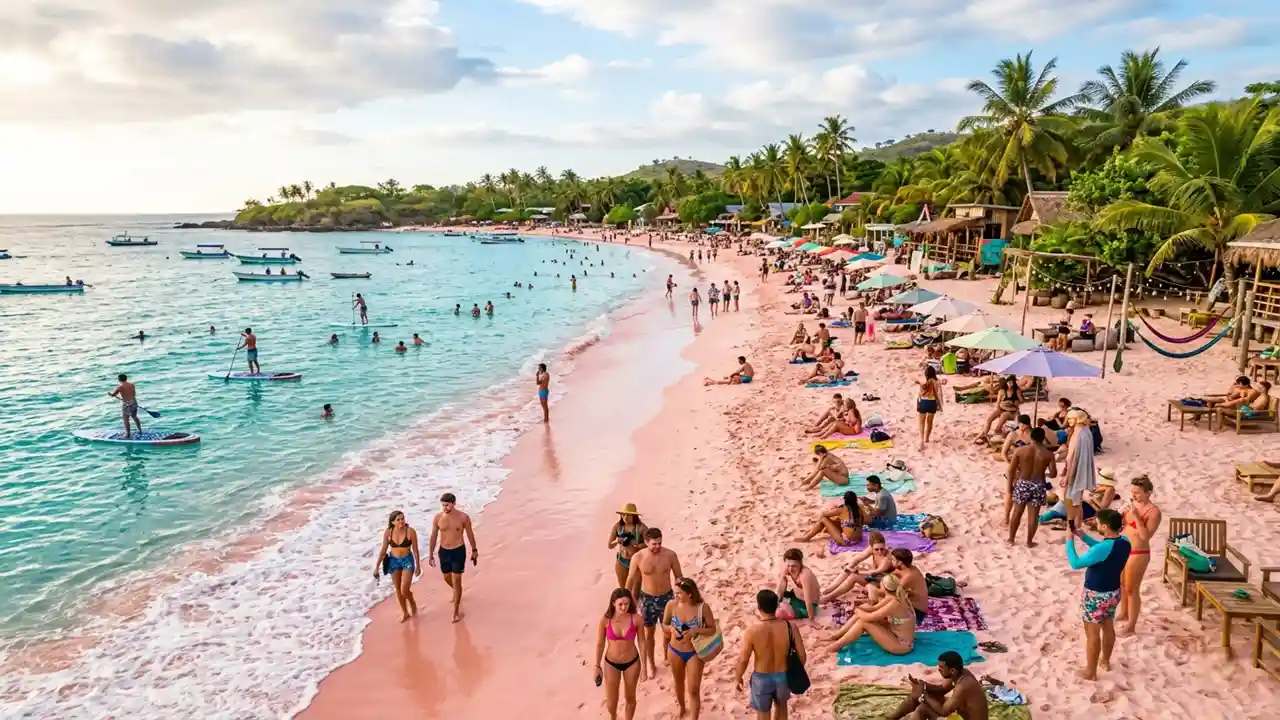
Indonesian authorities just announced stricter preservation laws to protect the fragile ecosystem of Komodo’s iconic pink beach.
This decision comes as exploding social media attention threatens the delicate marine organisms that give the coastline its rare, rosy hue.
Key Takeaways
- Preservation Crisis: Surging tourism is directly threatening the microscopic organisms responsible for the shores’ unique coloration.
- Cultural Shift: Local communities are successfully transitioning from traditional fishing economies to sustainable, heritage-driven tourism frameworks.
- New Mandates: Global travel authorities are instituting strict carry-in, carry-out policies alongside mandatory cultural orientation briefings for all international visitors.
Koh Tao Shift: the New Travel Safety Rules Mean For You
Why are these shorelines facing a cultural crisis?
If you have been following cultural travel trends, this news will not come as a surprise.
Our team observed that geographic wonders are no longer viewed merely as pretty backdrops for photos.
Instead, the modern traveler increasingly views sites like the famous pink beach as living cultural monuments that require active protection.
Industry insiders are noting that the pink sands hold deep spiritual significance for local indigenous populations.
The vibrant color comes from Foraminifera, tiny shelled organisms that mix with white quartz sand.
Local folklore has long celebrated this blending of the land and sea as a symbol of ancestral harmony.
Maine Hiking Acadia: the Best Trails and Overlooks
How will new regulations impact your next journey?
Our analysis suggests that travelers must fundamentally change how they interact with these delicate coastal environments.
Simply buying a plane ticket is no longer enough to guarantee access.
Governments are prioritizing long-term cultural preservation over short-term tourism revenue.
| Destination | Primary Cultural Threat | Implemented Policy Change |
| Komodo National Park | Overcrowding and illegal sand theft | Daily visitor caps and mandatory local guides |
| Harbour Island (Bahamas) | Large cruise ship pollution | Restricted docking hours and eco-taxes |
| Elafonisi (Greece) | Habitat destruction of rare flora | Complete vehicle bans and fenced pathways |
We found that destination management groups are seeing excellent results from these aggressive initiatives.
By limiting footprints, the natural ecosystems can slowly regenerate their signature hues.
What does this mean for cultural enthusiasts?
True preservation requires active participation rather than passive observation.
When communities lose their natural wonders, they frequently lose the oral histories and traditions tied to those spaces.
The global fight to save each threatened pink beach reflects a broader movement to protect localized coastal identity.
Local artists and elders are now leading the narrative by teaching visitors about the delicate balance of their marine ecosystems.
This pivot ensures that tourism dollars directly fund local heritage museums and schools rather than corporate agencies.
Evaluate Bolt Transport on Heathrow Airport to London
How to visit a pink beach responsibly
To ensure these shorelines remain intact for future generations, travelers must follow specific conservation protocols.
Our strategic team has compiled the essential steps you must take before stepping onto any protected pink beach globally.
1.Verify local permits and visitor caps:Do this 3 months prior.
Research the specific regional guidelines for your chosen pink beach, as many locations now require booking authorized entry slots months in advance.
2.Switch to certified reef-safe sunscreen:Do this during packing.
Purchase sun protection completely free of oxybenzone and octinoxate, which bleach corals and harm the organisms that generate the pink hues.
3.Participate in the mandatory cultural briefing:Do this upon arrival.
Attend the local community-led orientation session to understand regional taboos, historical context, and specific boundary rules.
4.Enforce a absolute zero-trace policy:Do this during the visit.
Pack out every piece of personal waste, and never collect sand, shells, or coral fragments as souvenirs, as doing so carries heavy legal fines.
How is Betanden different from other psychology in 2026
Why does local community ownership matter?
Our investigative team found that top-down government bans rarely work without grassroots backing.
Where local residents are given direct ownership of tourism initiatives, poaching and sand theft drop significantly.
The economic survival of these communities is now beautifully intertwined with ecological health.
Ancient fishing villages near each major pink beach are reinventing themselves as conservation hubs.
They are proving that cultural pride is often the most effective shield against environmental degradation.