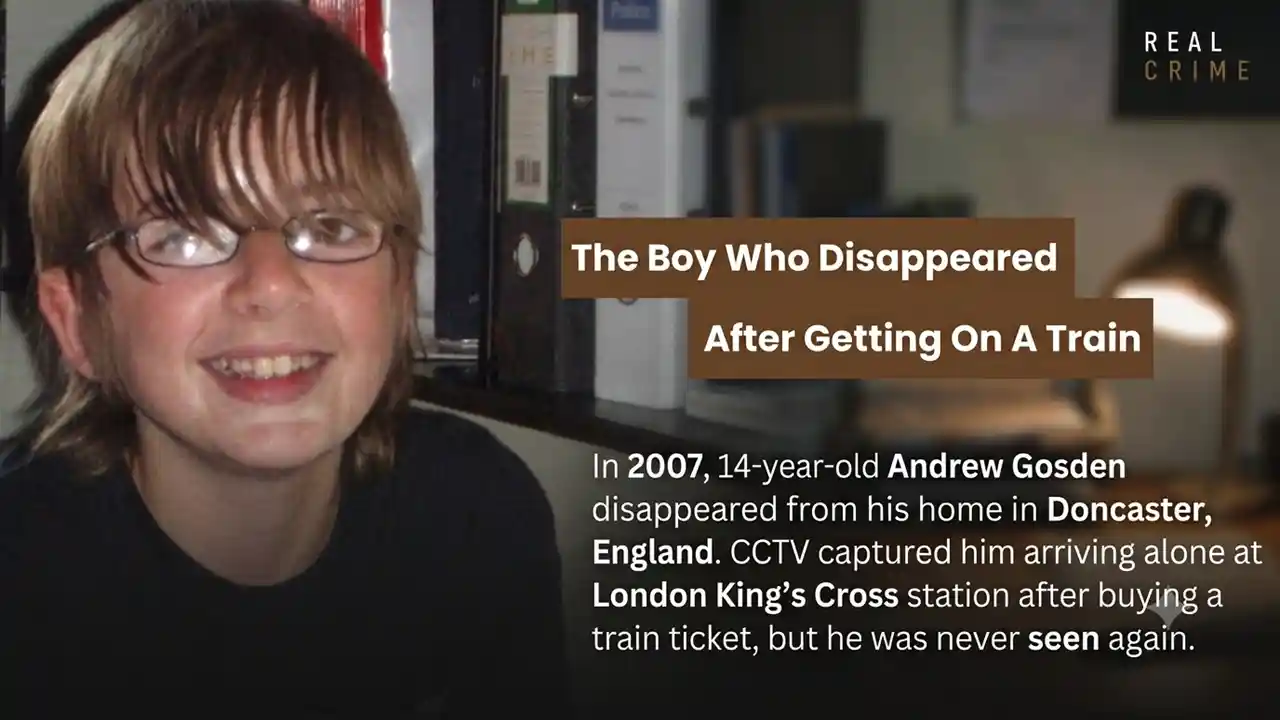
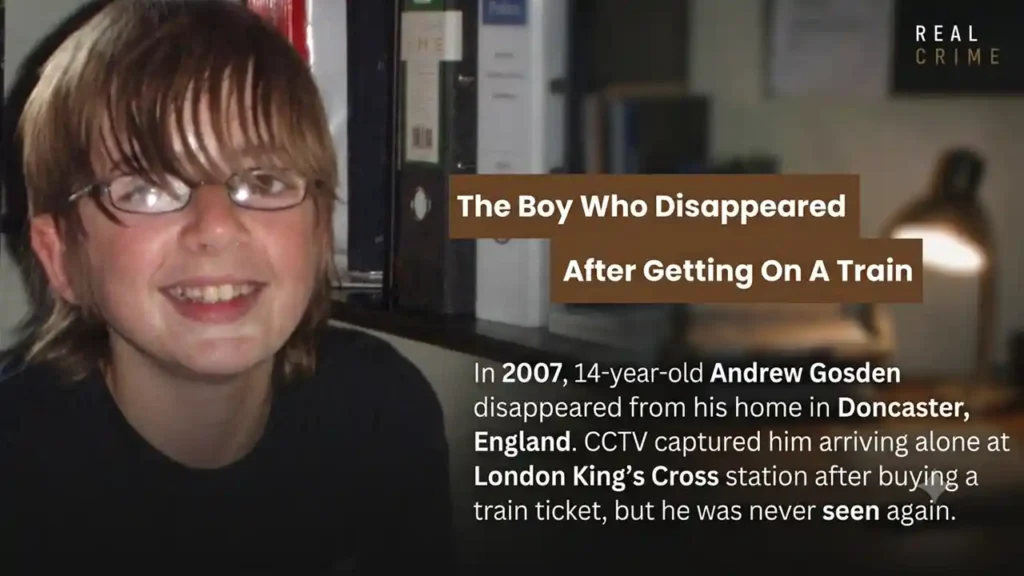
Some cases stay with you. The disappearance of Andrew Gosden is one of them. A bright, quiet 14-year-old boy left his home in Doncaster, England, boarded a train to London, and simply vanished. Nearly two decades later, his family still has no answers.
The Day Everything Changed
On the morning of 14 September 2007, Andrew Gosden left his family home as if heading to school. Instead, he took a very different path.
Rather than attending classes, Andrew emptied his bank account and made his way to Doncaster railway station. There, he bought a one-way ticket to London Kings Cross. Not a return. One-way.
That detail has haunted investigators, his family, and the public ever since. A one-way ticket suggests intent, planning, and a decision that a 14-year-old boy had somehow made on his own.
Boarding The Train Alone
At 9:35 AM, Andrew was spotted boarding the train by himself. He carried little with him and drew no obvious attention.
A woman who sat next to him during the journey later recalled that Andrew was quiet. Nothing about him seemed alarming in the moment. He was just a young passenger, keeping to himself, on his way to the capital.
No one who saw him that day could have known it would be one of the last confirmed sightings of Andrew Gosden.
The Last Confirmed Sighting
Andrew’s train reached London Kings Cross Station. And this is where the trail turns cold.
CCTV footage captured him leaving Kings Cross Station on that same day, 14 September 2007. He walked out of the station and into the city.
Then, nothing.
There was no further confirmed sighting. No verified contact. No trace. A 14-year-old boy stepped out into one of the busiest cities in the world and, somehow, disappeared without explanation.
A Case That Remains Unsolved
Despite the passage of time, media coverage, and continued public interest, Andrew Gosden’s case remains unsolved.
Witnesses recalled seeing him on the train. Cameras caught him at the station. But beyond that point, the questions only multiply:
- Why did he empty his bank account?
- Why did he buy a one-way ticket?
- Where did he go after leaving Kings Cross?
- Who, if anyone, did he meet?
These questions still have no answers.
A Father Who Never Stopped Searching
For Kevin Gosden, Andrew’s father, the years have not brought peace. He has spent nearly two decades trying to find out what happened to his son.
In his own words, the not knowing is almost impossible to bear.
“He walked out of the station, but someone, somewhere, must have seen him, noticed him, spoken to him, surely?”
Kevin has spoken openly about the weight of living without answers.
“We’re now talking 17 years after Andrew went missing and we still wonder if he’s dead or alive.”
And perhaps most heartbreaking of all:
“Every year that goes by feels like a year further away from getting any possible answer to what on earth happened — and we still miss Andrew.”
His words capture something that statistics never can. A missing person is never just one person. It is a family, a home, and a life left permanently unsettled.
“It’s not just about that missing person. It’s about the whole family and friends. It really does have a huge impact on more people than you think about.”
How Andrew’s Story Is Changing Rail Safety
Out of this painful case, something meaningful has started to grow.
LNER, the company that operates services between Doncaster and London, now provides safeguarding training to its rail staff. The goal is simple but powerful: help employees recognize and support vulnerable people before they slip through the cracks.
The results have been striking. According to LNER, in a single 12-month period, its staff:
- Found a total of 126 missing people
- Referred more than 500 people for support from social services, mental health teams, or charities
Jim Rawcliffe, LNER’s security and emergency planning manager, explained the approach.
“We train our staff to look out for anyone who might be distressed, concerned, or just not look at ease with the surroundings.”
The heart of the training, he said, is human connection.
“It’s just trusting your gut feeling that something isn’t right and doing something about it.”
Kevin Gosden has welcomed this work, saying it “has the potential to really change a lot of lives.”
Why Trains Draw Vulnerable People
The Missing People charity has played a key role in raising awareness around cases like Andrew’s, and in supporting those at risk.
Martha McBrier, the charity’s helpline manager, shared a sobering insight. Her staff speak to around three people every day on trains or at stations who say they are either missing or thinking about going missing.
She explained why railways so often become part of these stories.
“It’s this notion of feeling safe or feeling like something is moving that they can go somewhere.”
And sometimes, she added, there isn’t even a clear destination.
“Sometimes they might arrive and not even know where it is they want to go, but they just get on a train because it’s somewhere safe they can be.”
That observation adds a quiet, painful layer to Andrew’s own journey. A boy, alone, on a train — moving toward something none of us can name.
The Questions That Still Remain
Nearly two decades on, the disappearance of Andrew Gosden continues to unsettle everyone who hears it. He was 14 years old. He was quiet. He was loved.
He bought a one-way ticket, boarded a train, walked out of Kings Cross Station — and was never confirmed to be seen again.
His family still waits. His father still searches. And the case remains open, unsolved, and painfully unfinished.
Have Information? Speak Up
If you have any information about Andrew Gosden, or if you ever notice someone who seems lost, distressed, or in danger while traveling, say something. As LNER’s safeguarding work has shown, a single moment of attention can change or even save a life.
Andrew’s story is a reminder that missing people are never truly forgotten. Somewhere, a family is still hoping for answers.